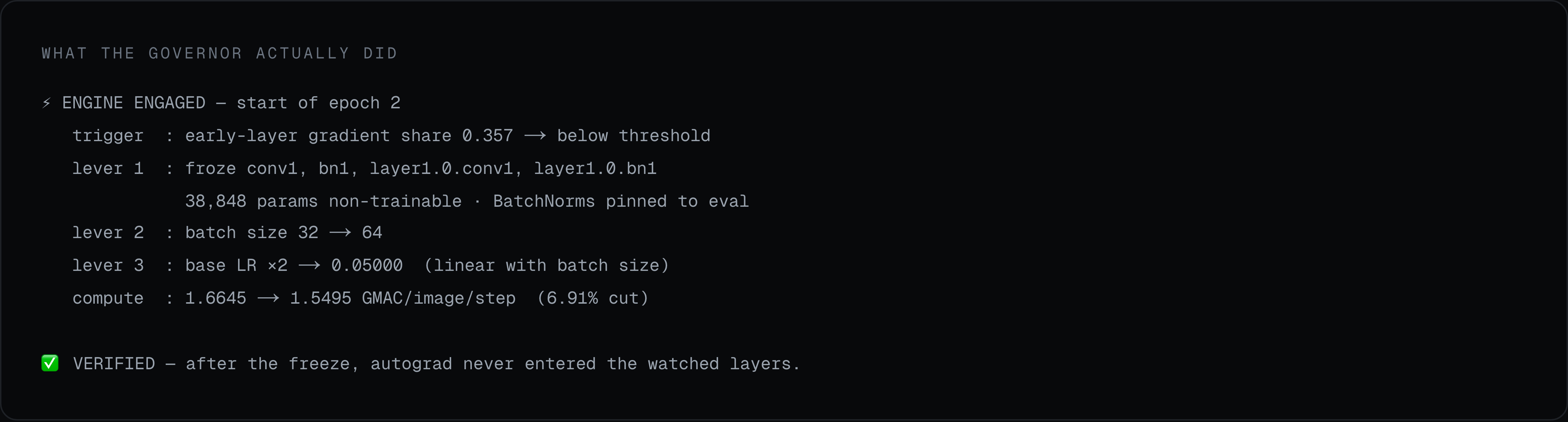
A training run keeps computing gradients for layers that stopped learning hours ago. EnAi watches gradient energy per layer while the run is in flight, freezes each layer the moment its contribution collapses, and raises the batch size into the headroom that frees up. All of it happens mid-run, with no restart and no change to the model code.
Solo. I build the engine, the study and the measurement.
6.91%
training compute removedAnalytic ledger, confirmed by autograd
+20.9%
throughput once engagedMachine normalised, median of 12 runs
1,563 to 0
backward passes into frozen layersCounted per layer by hooks left attached
92%
of the theoretical ceiling reached+7.42% predicted, +6.85% measured
Production safeguards for LLM calls, in one decorator.
Every team putting a language model in production writes the same safeguards: retry the rate limits, cache the repeats, fail over when a provider is down, cap the spend, keep customer data out of the prompt, and make sure the answer parses. callm puts all of that behind one decorator on the function you already wrote, so the OpenAI, Anthropic or Gemini call inside it stays exactly as it was. No gateway to deploy, no database to run, and nothing required beyond the standard library.
A small group building AI products around one question: what is still harder than it needs to be? Everything ships free and open source. The first product out is Admission OPS, because university admissions is one of the most paperwork heavy moments in a person's life and most of it is deadline tracking that software should have absorbed years ago.
Browser video calls, built twice: raw WebRTC and a managed SDK.
A browser video calling app in React, built two ways: a peer to peer version on WebRTC (simple-peer) with Socket.IO handling signalling and connection state, and a production version on the ZEGOCLOUD SDK. Building both made the trade off concrete: owning signalling versus shipping reliable calls fast.
P2PWebRTC version with no media server in the path
Product search over data that never agrees with itself.
A product search and comparison tool over external APIs that return the same field in a different shape every time. The work is in the normalisation layer and the caching: filtering and sorting happen against a cleaned local shape, so the interface stays responsive instead of waiting on a round trip per keystroke.
Emotion and a summary from a voice recording, via small AI flows.
A Next.js and TypeScript app that takes a voice recording and uses Google Gemini through small Genkit AI flows to detect the speaker's emotions and write a short summary. Built with a team at Hackaburg 2025, where it placed in the top 10 of 198.